Hiển thị các bài đăng có nhãn D.I.Yogyakarta. Hiển thị tất cả bài đăng

Thứ Năm, 10 tháng 11, 2016

Water Castle, Taman Sari in the Sultane Palace of Yogyakarta.

 Gedong Gapura Panggung,The front door of Taman Sari.
Next to Bali,Yogyakarta is today the  most desirable tourist destinations in Indonesia, offering a variety of tourist attractions ranging from natural attractions, historical tours, to culinary. One of the many historical sites in Yogyakarta is the Taman Sari,Water Castle located at Jalan Taman, Yogyakarta.
The gate into bathing pools.
Taman Sari is located very close to the palace of Yogyakarta Sultanate and only took about 15 minutes from the north square of the palace. This place was once a place of recreation for the royal family as well as the fortress was built in 1758-1765 by the Sultan Hamengku Buwono I. Now, Taman Sari Water Castle is one of the cultural heritage of Yogyakarta, which has become a popular tourist spot in the city.
Umbul Pamuncar,The Bathing Pool For King's Wifes.
Taman Sari was, or Beautiful Garden, used to for three functions, namely as : a defense area and a shelter as indicated by the high fortress which suroounded Taman Sari; the bation or a place to set the weapons; the gates equipped with the guard posts; and the underground tunnels that connects one area to others sych as from Margi Inggil to Pulo Kenanga, from Pulo Kenanga to Sumur Gumuling, Sumur GUmuling to Gerbang Segaran, on the western side of Taman Sari.

Taman Sari also functioned as a religious place. The buildings used by th Sulthan for religious service and meditation were Pulo Penembung and Sumur GUmuling, located in the middle of Kolam Segaram,. Pulo Penembang is located on the south of Pulo Kenangan and Sumur Gumuling is on the west of Pulo Kenanga.

Lastly, Taman Sari as a recreation/ Resting place. There are many facilities for recreation and retreat such as a bathing place complex, pools, ponds, arificial lake, and gardens. During its era, the artificial lake was streching from Pulo Kenangan to Pula Gedong the east of Palace. Through a ditch called Kali Larangan, Segawan water was directed from the Bendalole dam at Winongo river,  Pingit, on the northwest side of Yogyakarta. Other facilities related to water are pools or ponds such as Umbul Binangun, Kolam Garjitawati, Pasiraman Umbulsari adn Kolam Nagaluntak.

 
The Buildings with initial area of 10 hectares  has 57 buildings, consisting of a complex of bathing pools, artificial lakes, artificial islands, suspension bridges, canals, parks, underground passageways, as well as several buildings with European architecture, Chinese, Javanese, Hindu, Buddhism, and Islam.  The compound is a make up of four complexes namely:  Artificial lake,"Segaran" located in the west, where you will find Pulo Kenongo, Pulo Cemethi, serta Sumur Gumuling.
Umbul Panguras,The Bathing Pool For the Sultan.
Pulo Kenongo is an island in the middle of an artificial lake complex of Taman Sari. Here there is a building named Gedhong Kenongo, the building which was once the highest place in Keraton Yogyakarta making it possible to view the region as a whole palace. In the vicinity there are air vents for underground tunnels that can be used if it will escape from the enemy.You can see the sunset here because until now, the place is still one of the tallest buildings in Yogyakarta. Against the backdrop of the city of Yogyakarta, the sunset will be very memorable.
Umbul Kawitan,the Bathing Pool For the King's sons and daughters.
Pulo Cemethi located south Pulo Kenongo sultan is ideally used for meditation. Pulo Cemethi To achieve this, you must pass through an underground tunnel. 
The Traditional Sauna  for the Royal Family.
Gumuling well is located in the western part of Pulo Kenongo and a place of worship Sultan who can be reached through an underground tunnel. Although intended as a mosque, the well is different from the mosque in general because of the circular-shaped niche. Gumuling wells consist of two floors, the first floor is the assembly of men, while the second floor is a place for female pilgrims. 

In the Gumuling Well, if you speak loudly so your voice will be heard throughout the building. In the middle of the well, there are five ladders that implies five pillars of Islam, four of them up and merge in the middle, while the fourth-fifth connecting the ladder to the second floor . Under the stairs, you will find a pool of water which is ablution for pilgrims.

The second complex of Taman Sari has several buildings, namely:
a. Gedhong Gapura Hageng;Gedhong Hageng Gate is the main gateway to the west, but now it is not used anymore and the main entrance for visitors has been transferred to the east. Gedhong Hageng gate has a two-level room decorated with reliefs to describe the initial years of development of Taman Sari, namely 1765.

b. Gedhong calyx-calyx (Gopok-Gopok);This building was once a 2-storey tower, but now the building is gone and replaced by eight square garden.

 c. Pasiraman pennant (pennant Binangun);Bannerman Pasiraman or commonly known as Bannerman Binangun a bathing place along with the daughter of the sultan and his harem surrounded by high walls on each side. Bannerman Pasiraman has 3 pools named pennant Muncar, Blumbang Kuras and Binangun banners emblazoned with mushroom-shaped fountain and can be accessed through two entrance gates on the west and east.

 d. Gedhong Sekawan;Located east Umbul Pasiraman and form pages with four buildings as a resting place sultan.

 e. Gedhong Gapura Stage;Currently Gedhong Stage Gate is the main entrance gate used by a visitor to enter the Taman Sari complex and is located east of Taman Sari Water Castle. This 2-story building has a snake reliefs on the walls, depicting the completed construction of Taman Sari, namely 1758.

 f. Gedhong temanten;The building is located in the east Gedhong Gapuro stage and used as a place of custody.
 
Gedong Gapura Hageng, the ex Front Gate of Taman Sari.

Source : Leaflet on Taman Sari Ngayogyakarta as based on Eka Hadiyanta, IGN., menguak Keagungan Taman Sari, Sumber Aksara Yogyakarta, 2012.

Thứ Tư, 9 tháng 11, 2016

Exploring Museums in DIY Yogyakarta.


The most famous as well as unique museum of all in DIY Yogyakarta is the museum complex of Sultanate Palace of Yogyakarta or Keraton Ngayogyakarta. In Yogyakarta Palace complex is made of four museums, namely Batik Museum, the Museum of Painting, Crystal Museum, and Museum of Sultan Hamengkubuwono IX. Fourth museum is fused with the other buildings in the keratin and becomes part of the tourist attractions.  

Yogyakarta Palace Museum is really unique and unbeatable because it is located inside the palace complex that there are courtiers keratin, complete Javanese clothes they were good at playing the gamelan. Music playing gamelan which can be watched and enjoyed by visitors every Monday and Thursday.

Batik Museum occupies two unit building. Batik Museum Building Unit 1 contains a collection of fabrics, scarves, semekan, headbands, surjan and lonthong granting of the royal family. Batik collection in this room is dominated by brown color and motif parang. That said, batik parang motif is the motif of the royal family. Batik Parang Barong which is the coronation of the Emperor Hamengkubuwana clothing VIII in 1921 was one of the valuable collections displayed in this room

There is also a daily fashion Sultan Hamengkubuwono IX patterned Parang Rusak Cohong and headbands Parang Kestubo. One of the most attention is the motif Kawung Gringsing Box Puppet belongs and works Kray Retno Wilanten Hamengkubuwana VIII (concubine Sultan Hamengkubuwana VIII).

In contrast to the first unit, Unit 2 Batik Museum contains photographs of children and grandchildren of Sultan Hamengkubuwono IX when the wedding ceremony, ceremony mitoni, tedhak Siten, circumcisions and ceremonies droplets. In addition to display photographs in the Museum Unit 2 also displayed batik clothing worn in the photos.

Museum painting in keratin complex also consists of two buildings. In the first building, exhibited paintings genealogy of the kings starting from Lineage I. Hamengkubuwana depicted in the form of a tree with fruit that symbolizes the boy and leaves symbolizing girls.

Valuable museum collection was exhibited at the second building that used to serve as the home of the crown prince. The painting is a portrait of Sultan Hamengkubuwono VII, painted by Raden Saleh in 1868. These paintings are very European. Sultan Hamengkubuwana VI painting featuring the king dressed in Javanese batik parang motif, while the painting of Sultan Hamengkubuwono VII warrior dressed in full.

Goods, such as flower vases, urns, clock, gear sets eat / drink, and lamps made of silver, porcelain and crystal belongs to the king, on display in the Museum of Crystals. These objects are mostly from abroad. The most unique is the collection of ceramic wall clock whose numbers are written in Java letter.

In addition, the life story of Sultan Hamengkubuwono IX enshrined in its own museum which consists of four rooms. The most important collections in the room to-1 is a Charter determination of Soekarno regarding Yogyakarta as part of RI, also mandate that says that the Sultan of Yogyakarta Special Region RI is. In the 2nd room featuring photographs and relics of the Sultan when he was a child. In room 3, displayed photographs and relics of him as warriors, governors and vice-president of Indonesia. Valuable collection for the museum is a painting him as the crowning of Sultan Hamengkubuwono IX complete with all the tools during the coronation ceremony. Stories about the life story of Sultan Hamengkubuwono IX in the museum ends with a photograph at his funeral in 1988 and plans keletakan his tomb in Imogiri (room 4th).


Exploring Temples in Yogyakarta.


Buddhism Statue in Borobudur Temple.
Probably not many aware that DIY (Special Region) Yogyakarta has so many religious buildings  in the form of temples or candi, either Hinduism or Buddhism, apart from Mosques and churches. Yet,historically, Javanese in Yogyakarta in the pre-islam era were predominantly Hindus with minority believed in Buddhism.
The existence of a large number of temples in Yogyakarta and its neighboring region beckons the travelers, from other provinces in Indonesia as well as foreign countries to visit this tourism destination that is tolerant, spiritual and most of all diverse yet united.


Let us together get acquainted to a different side of the region and learn about these fascinating religious tourism places in Yogyakarta.  The famous of all temples here is Borobudur Temple. Although administratively no longer in Yogyakarta but In Magelang regency, Central Java province, most visitors prefer to get access into the temple from Yogyakarta since its location is conveniently situated close to Yogyakarta. Together with Prambanan Temple and Ratu Boko Temple, in order to better manage this World heritage site, Borobudur Temple is now under management of PT Taman Wisata Borobudur Prambanan & Ratu Boko. visit http://corporate.borobudurpark.com/for more information.


Borobudur was built around 800 AD or 9th century. Borobudur was built by the followers of Mahayana Buddhism during the reign of the Sailendra dynasty. The temple was built in the heyday of the Sailendra dynasty. The founder of the Borobudur Temple, King Samaratungga derived from the dynasty or the Sailendra dynasty. Likelihood of this temple was built around 824 AD and was completed around the year 900 AD during the reign of Queen Pramudawardhani who is the daughter of Samaratungga. While the architects who contributed to build this temple according to stories passed down through generations named Gunadharma.


Borobudur has 10 levels consisting of six levels of a square, circular level 3 circular and a main stupa as a peak. At every level there are several stupas. Altogether there are 72 stupas in addition to the main stupa. In every stupa there are statues of Buddha. Ten levels of Buddhist philosophy which ten levels of Bodhisattva who must pass to reach the perfection of the Buddha in nirvana. This perfection is symbolized by the main stupa at the top level. Borobudur structure when viewed from above form a mandala structure depicting Buddhist cosmology and human thinking.


Borobudur is one of the wonders of the world that should be preserved. Borobudur is currently designated as one of the UNESCO World Heritage.Borobudur has become a tourist attraction which attracts many tourists both local and foreign. Additionally, Borobudur has become a holy place for Buddhists in Indonesia and an annual celebration of the most important centers of Buddhist namely Vesak.


The next after Borobudur Temple is Prambanan Temple. Prambanan Temple, or Roro Jonggrang Temple, is the masterpiece of Hindu culture in the 10th century. Candi Prambanan or Candi Roro Jonggrang is the largest Hindu temple complex in Indonesia and dedicated to Trimurti, the three main Hindu gods Brahma as the creator god, the god Vishnu as the preserver, and Shiva the god of destruction.


This temple is also UNESCO World Heritage Site, and one of the most beautiful temples in Southeast Asia. The architecture is tall and slender shape in accordance with Hindu architecture in general with the Shiva temple as the main temple has a height reached 47 meters towering in the middle of the complex cluster of temples are smaller. As one of the grandest temples in Southeast Asia, Prambanan temples to attract tourists visiting from all over the world.


The temple complex is located in the district of Prambanan, Sleman and sub Prambanan, Klaten, approximately 17 kilometers northeast of Yogyakarta, 50 kilometers southwest of Surakarta and 120 kilometers south of Semarang, just on the border between the provinces of Central Java and Yogyakarta. It is very unique, Prambanan temple is located in the administrative area Bokoharjo village, Prambanan, Sleman, while the entrance to the Prambanan temple complex is located in the administrative region Tlogo village, Prambanan, Klaten.


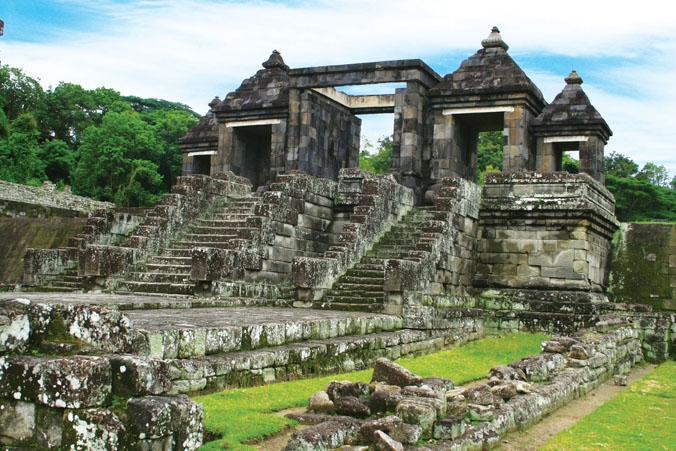
Other temple under the same management is Ratu Boko Temple.Ratu Boko or Boko temple (Javanese: Candhi Ratu Baka) is an archaeological site which is a complex number of the rest of the building which is located approximately 3 km south of the Prambanan complex, 18 km east of Yogyakarta or 50 km southwest of the City Surakarta, Central Java, Indonesia. 

Ratu Boko is an archaeological site in the form of royal palace of Mataram Kingdom from the 8th Century. Ratu Boko is situated on a hill, about three kilometer south of Prambanan Temple at an altitude of 196 meters above sea level. The area of the whole complex is about 25 ha. Administratively, the site is located in the region of two of Hamlet, namely Hamlet Dawung, Bokoharjo Village and Hamlet Sumberwatu, Sambireja village, Prambanan subdistrict, Sleman, Yogyakarta, Indonesia. 

Hasil gambar untuk ratu boko jogja
Sources: cited from a number of  articles.

Thứ Sáu, 19 tháng 8, 2016

Mount Merapi Lava Tour in Jogjakarta

Jeeps of Lava Tour.

Mount Merapi (peak altitude of 2930 m above sea level, as of 2010) is a volcano in the central part of Java Island and is one of the most active volcanoes in Indonesia. South side slope lie in the administrative district of Sleman, Yogyakarta, and the rest  in the region of Central Java province, namely Magelang district on the west side, Boyolali district in the north and east, and Klaten district on the southeast side.

The Mount is very dangerous because, according to modern records it experiences eruption every two to five years and is surrounded by a very dense settlements. Since 1548, the mountain had erupted 68 times. Magelang and Yogyakarta is the nearest large town, is under 30 km from the summit. On the slopes there is still a settlement to an altitude of 1700 m and is just four kilometers from the summit. Because of this importance, Merapi became one of sixteen world volcanoes  included in the project of Decade Volcanoes. 

The two eruptions of Mount Merapi in the last decade -2006 and 2010-has devastated the surrounding settlement including National Park Mount Merapi. Kaliadem is among heavily impacted by the two eruption.After the eruption of Merapi in 2006 and 2010, the face Kaliadem has changed which was once a green area of campground with a very wide expanse of land. The area is now buried by former Merapi lava and used for Merapi Lava Tour Kaliadem. You can see from nearby Mount Merapi eruption waste materials and can watch a bunker shelters that claimed the lives of two volunteers.

The Lava Tour  is expected to make tourists  understand how powerful the eruption of Mount Merapi was. Besides, With lava tour, tourists can see the peak of Mount Merapi with a visibility of about 2 km. Mountain altitude is 2,965 m above sea level emitting sulfate fumes that can never stop rising from the crater.

Kaliadem that was once a campground equipped with facilities such as basecamp climbing, substation view, food stalls, toilets and mosque now the buildings were buried and only visible on some parts of the building that once there has been destroyed.

Other Merapi malignancy we can see is a bunker for hideout the volunteers at the times. The bunker actually built for protection when the time Merapi spewing hot clouds. However eruption, in 2006, in addition to spewing hot clouds also spewing material in the form of sand and hot rocks are able to topple Geger Boyo Hill (hill located to the south of Merapi, so that Kaliadem submerged).


As a result of the hot material stockpiled bunker 3 m thick with the heat of about 1000 ° C. Although the bunker is made of 25 cm thick concrete and iron door, but the heat received so big that it could get into the lead two volunteers died of heat. A volunteer found dead soaking in the tub, while another was killed in front of the iron door.


The bunker has now been cleaned and painted white, in front of the bunker door there is an inscription tells the history of the bunker. A Visit at night in Kaliadem will be very interesting because tourists can see molten lava down a lava dome. It's just that this scene can be seen at night.

Source: http:wikipedia.com and http://www.njogja.co.id/sleman/lava-tour-merapi/


Thứ Ba, 7 tháng 6, 2016

Visit DIY Yogjakarta : Museum of the Yogyakarta Sultanate Palace (Keraton Yogyakarta).


Keraton Yogyakarta (Yogyakarta) or often referred to Ngayogyakarta Palace is located in the heart of the province of Yogyakarta Special Region (DIY), Indonesia. Because it is located in the center of Yogyakarta, which is taken as a straight line between Mount Merapi and the South Sea, the palace became the center of both.
Royal Musical Instrument, Gamelan.
Keraton or Kraton Jogja is the last of all the royal kingdom who had triumphed in the land of Java. When the Hindu-Buddhist kingdom ended then forwarded to the first Islamic kingdom in Demak, and other royal standing as the Islamic Mataram was founded by Sultan Agung and running and appears Kraton Yogyakarta or Yogyakarta Sultanate Palace which was founded by Sultan Hamengku Bowono I. Until now, the palace of Yogyakarta still preserving the culture was amazing.

During its development, the Keraton Jogja many had their ups and downs leadership schism. The most famous is Giyanti agreement in 1755, in which the kingdom was divided into 2 (two) the eastern region which is now a palace of Surakarta (solo - the next adventure) and the western region called the Sultan of Jogjakarta. However, the Keraton Jogja also keeps a history that can not be forgotten by the people of Indonesia, including in the struggle for Indonesian independence and maintain.
The Appearance of Abdi Dalem,or Inner Royal Servants.
In addition, the Keraton Jogja is very thick with cultural heritage of ethnic Javanese very amazing that still can be found around and within the palace itself. When adventurers to Sultan of Yogyakarta then, that's the simple description of the culture and beauty of the land of Java. Represented in almost all the interesting places and very intriguing. How not, in the palace is still a lot to save on a variety of arts, culture results, a variety of custom clothing and form a beautiful Javanese-style house. Does not stop there, in the palace of Yogyakarta also demonstrate how the Javaness flexibility in communicating and friendly with all the people who come there. Very exotic and interesting.
The Statue of A Javaness Women Painting Bateeq.
Adventurers are not required to wear a hat or sunglasses when entering into the palace, nothing just to honor the culture Javanese. Hours of visit to the palace for the day Sunday and other days in the limit of 07 hours am - 12 pm. Tips: Please to come to the palace of Yogyakarta around 9, because there is a typical Javanese dance performances as Serimpi nicely done and amazing.
The Photo of The Last King, Sultan Hamengkubuwono X.
In the palace also served in a variety of beautiful Javanese culture such as batik, which is Javanese cultural heritage that has been recognized internationally. Some paintings, kris, Javanese kings photos, genealogy king of Java, and the various results of Javanese culture. When entering the home of batik, there is forbidden to take pictures. Because all there is a characteristic motif Kraton Yogyakarta which is a symbol of Javanese palace may only be printed and used in the palace alone. Various castle motif is very interesting indeed, unique design and different from most of batik.
Museum of Sri Sultan Hamengkubuwono IX.

Where to stay in Special Region (DI) of Yogyakarta : List of Hotels

The 101 Yogyakarta Tugu Hotel.

**** Hotel

Grand Quality Hotel Yogyakarta
Alamat di jalan Laksda. Adisucipto Nomor 48 Yogyakarta INDONESIA 55281
nomor telepon +62-274-485005, 487100  nomor faksmile: +62-274-489009, 486965 
    
Hotel Novotel Yogyakarta
Alamat di jalan Jend Sudirman Nomor 89 Yogyakarta INDONESIA 55223
nomor telepon +62-274-580930  nomor faksmile: +62-274-580931 
    
Hotel Sahid Raya Yogyakarta
Alamat di jalan Babarsari, Yogyakarta INDONESIA 55281
nomor telepon +62-274-488-888  nomor faksmile: +62-274-487-688 
    
Hotel Santika Premiere Jogja
Alamat di jalan Jendral Sudirman Nomor 19 Yogyakarta INDONESIA 55233
nomor telepon +62-274-563036, 562743  nomor faksmile: +62-274-563669 
        
Inna Garuda Hotel Yogyakarta
Alamat di jalan Malioboro Nomor 60 Yogyakarta INDONESIA 55213
nomor telepon +62-274-566353, 566322  nomor faksmile: +62-274-563074 
    
Jogjakarta Plaza Hotel Yogyakarta
Alamat di jalan Affandi - Gejayan, Complex Colombo, Jogjakarta INDONESIA 55281
nomor telepon +62-274-584222  nomor faksmile: +62-274-584200 
    
Saphir Yogyakarta Hotel
Alamat di jalan Laksda Adisucipto Nomor 38 INDONESIA 55001
nomor telepon +62-274-566222  nomor faksmile: +62-274-566220 
    
The Jayakarta Yogyakarta Hotel & Spa
Alamat di jalan Laksda Adisucipto Km. 08 Yogyakarta INDONESIA 55282
nomor telepon +62-274-488418  nomor faksmile: +62-274-485415  


****Hotel 

The 101 Yogyakarta Tugu Hotel
Alamat: Jl. Margo Utomo No.103, Gowongan, Jetis, Kota Yogyakarta, Daerah Istimewa Yogyakarta
 
***Hotel 
 
Abadi Hotel Jogja
Alamat di jalan Pasar Kembang Nomor 49 Yogyakarta INDONESIA 55271
nomor telepon +62-274-563435  nomor faksmile: +62-274-513114 
    
Cakra Kusuma Hotel
Alamat di jalan Kaliurang Km. 5,2 Nomor25 Yogyakarta INDONESIA
nomor telepon +62-274-588 066  nomor faksmile: +62-274-550 470 
    
Dusun Jogja Village Inn Yogyakarta
Alamat di jalan Menukan Nomor 5 Karangkajen Yogyakarta INDONESIA 55153
nomor telepon +62-274-373031, 384438  nomor faksmile: +62 274-382202 
    
Gowongan Inn
Jalan Gowongan Kidul nomor 50 Yogyakarta
nomor telepon +62-274-541999  nomor faksmile: +62-274-561460 
    
Hotel Brongto Yogyakarta
Alamat di jalan Suryodiningratan Nomor 26 Yogyakarta INDONESIA 55141
nomor telepon +62-274-382602  nomor faksmile: +62-274-387022 
        
Hotel Ibis Malioboro Yogyakarta
Alamat di jalan Malioboro Nomor 52-58 Yogyakarta INDONESIA 55001
nomor telepon +62-274-516974  nomor faksmile: +62-274-516977 
    

Hotel Mutiara Yogyakarta
Alamat di jalan Malioboro Nomor 18 Yogyakarta INDONESIA 55213
nomor telepon +62-274-563814  nomor faksmile: +62-274-561201 

PP Convention Hotel Demangan Yogyakarta
Alamat di jalan Demangan Baru Nomor 8 Yogyakarta INDONESIA 55281
nomor telepon +62-274-588380  nomor faksmile: +62 274-588908

Puri Artha Hotel Yogyakarta
Alamat di jalan Cendrawasih Nomor 36 INDONESIA 55281
nomor telepon +62-274-563288  nomor faksmile: +62-274-562765

Sejahtera Family Hotel & Apartment Yogyakarta
Alamat di jalan Pringgondani Nomor 22 Demangan Baru Yogyakarta INDONESIA 55281
nomor telepon +62-274-511355  nomor faksmile: +62-274-519338 

**Hotel

Duta Garden Hotel Yogyakarta
Timuran MG III/103, Yogyakarta, Indonesia.
              
Grage Hotel Yogyakarta
Alamat di jalan Sosrowijayan Nomor 242 Yogyakarta INDONESIA 55271
nomor telepon +62-274-560125  nomor faksmile: +62-274-584759 
    
Hotel Arjuna Plaza Yogyakarta
Alamat di jalan P. Mangkubumi Nomor 44 Yogyakarta INDONESIA 55232
nomor telepon +62-274-513063  nomor faksmile: +62-274-561862 
        
Hotel Matahari Yogyakarta
Alamat di jalan Parangtritis Nomor 123 Yogyakarta INDONESIA 55153
nomor telepon +62-274-372020  nomor faksmile: +62-274-372020 
    
Rumah Palagan Yogyakarta
Alamat di jalan Palagan Tentara Pelajar Km 7,8 Ngaglik Yogyakarta INDONESIA
              
Sriwedari Business & Resort Hotel Yogyakarta
Alamat di jalan Laksda Adisucipto Km. 6, Nomor 6 Yogyakarta INDONESIA 55281
nomor telepon +62-274-488288  nomor faksmile: +62-274-485656 
    

Bài đăng phổ biến