Hiển thị các bài đăng có nhãn Italy. Hiển thị tất cả bài đăng

Thứ Bảy, 31 tháng 10, 2015

Venice, A Fantastic Tourists City in Italy

Venice is a city in Europe filled with numerous tourist attractions and amazing city to visit and enjoy your vacations. Tourism is one of the major sectors of the city from four centuries. After visiting its beautiful cityscape, uniqueness, and rich musical and artistic cultural heritage, visitors can’t control themselves falling in love with this city. It is an interesting fact about this city that Venice has the population of less than 300,000 and without roads and cars Venice City still, with bursting tourist traffic, ranks in top 30 destinations in world.  

Gondol 
Venice is an expensive place for tourists but you can save your money and make your tour to Venice cheap by using some good tricks such as book a small residence in cheap price and look some small café or hotel for food. There are three, four, and five stars hotels all around. No problem for your residence here in hotels or hostels. Tourists can find centuries old hotels located along the Grand Canal but still they provide some impressive accommodations to tourists. Over 15 million visitors flock to Venice, Italy every year.

Canal Tour is on Top in all Venice Attractions

Get around Gondola in Venice

Where to start your tour of Venice? The answer is very simple, easy, and quick it is the canal tour. Your tour to Venice cannot be completed without experiencing canal tour. Actually Venice city of Italy is a compound of 117 very small islands formed by 177 small canals in a shallow lagoon. These islands are connected each-other by 409 pedestrian footbridges. While the biggest canal known as Grand Canal flows in between the city. The gondola ride is also very popular among tourists.
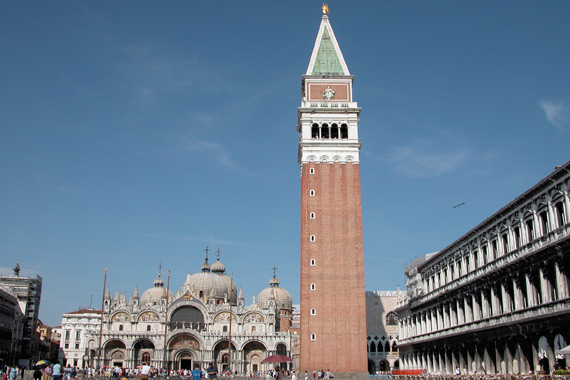
The gondola is a traditional Venetian rowing boat. There are over 400 gondoliers in Venice. The other top attractions of Venice are also unforgettable such as the 325 feet tall bell tower known as Campanile offers an amazing view of the city from top. Santa Maria della Salute and the Church of the Madonna are centuries old churches are other valuable and don’t miss sights.
Tourist can often see these small pedestrian bridges in Venice


St. Mark’s Square is another top attraction in Venice. It is located in front of St. Mark’s Bascilica Church. The famous Fell tower is also located here. The square is often crowded with tourists. It is necessary to save your money for Cruise tour in Venice. The large cruise ships are banned but small ships can fulfill your desire. Your wish of eating Italian food can easily be completed in Italian restaurants. Italian cuisine is a must to try. Overall, Venice is a beautiful and eye-captivating city which makes people fall in love with it completely.
Bell Tower


St. Mark’s Square

St. Mark’s Bascilica 

Thứ Ba, 29 tháng 9, 2015

Grand Canal, Venice (A Popular Tourist Attraction in Europe)

Grand Canal Venice at Night 

Venice canals are one of the most popular attractions of this ancient city in northern Italy. The whole city, which is located among over 100 islands in the Venetian Lagoon, and all islands are interconnected with a series of water-streets or water-roads. This is only city of the Europe where car driving is impossible or prohibited and this is a romantic charm of Venice.
In Venice city there are stunning 448 different tiny, medium, and large bridges over 150 small but picturesque canals. Some of the small bridges have very small footways while big bridges have wide paths. Of all the canals in Venice, The Grand Canal is standing above all. It is the main water traffic passageway in Venice. It is also known as Canalazzo by Venetians.  
The Canal Grande of Venice flows through the city just like in a large reverse “S” shape or snake shape (in the image given by NASA). One end of the canal leads into the lagoon (the Venetian lagoon is the enclosed bay of the Adriatic Sea) near the Santa Lucia Railway Station while other end leads into Saint Mark Basin. This ancient canal is approximately 2.5 miles long and its width ranges from 95 to 300 feet while depth is about 16 feet in most places and connects at various points with a network of small canals. Near the Grand Canal there are plenty of hotels to stay and numerous of restaurants (serve very delicious and verity of meals), cafes, bars, and many entertainment venues.
Some 170 number of buildings are located along with the Grand Canal Venice. Many of them give a reflection of old tradition and were constructed between the 1200s and 1700s and were built by rich Venetian families. Some of the most spectacular of all the palazzi that are pasted along the Grand Canal Venice include Ca’d’Oro, Ca’Rezzonico, and Ca’Foscari. Majority of the city’s traffic is provided by water buses (in Italian they are called vaporeti) and private water taxis, and the gondolas which are very famous among tourists. There was only one bridge that crossed until the nineteenth century (it is one of the interesting facts about the Grand Canal Venice). Two more Ponte degli Scalzi and the ponte dell’Accademia bridges were added which also cross this ancient waterway.

Famous Gondola

Water Taxi

The glorious past of Venice returns once a year to the Grand Canal during Regata Storica (Historical Regatta) on first Sunday of September, a boat race competition watch by thousands of people. The first boat races were held in fourteenth century.
Building around Grand Canal Venice, Italy

Thứ Tư, 16 tháng 9, 2015

Spanish Steps, Piazza di Spagna, Rome

The masterpiece of 18thcentury, a square having irregular shape but one of the most visually pleasing and one of the most popular meeting spots in Rome known as Piazza de Spagna. The place is a combination of three popular items including a long staircase, an obelisk (stone piller), and a stylish church. The Piazza de Spagna, also known as Spanish Square, is connected to a French Church located atop a hill called Trinita dei Monti, through a staircase (a long staircase) called Scalinata della Trinita dei Monti, best known as Spanish Steps. Spanish steps were built between 1723 –1726 to connect the church with the square below. The monumental staircase was built on the request of Innocent XII, and created by Italian architect Francisco de Sanctis.

The elegant staircase consists of 137 steps, usually very crowded with tourists as well as locals who use it as a gathering place, especially decorated with flowers in summer (in month of May when the ramps of the staircase are literally covered with flowers and the architecture is playfully lost beneath a magnificent array of color) and hosts a famous fashion show.
Trinita dei Monti (Church at Spanish Steps)

The building of church is beautiful and located on a hill, the Spanish steps can take to straight to the site. This square make the Trinita dei Monti (the Church) a popular land-mark in Rome. From here tourists can enjoy a nice view of the city. According to history, before 1495 there was only a small building existed on the hill. French King Louis XII decided to replace chapel with a new church. The construction started for new building in 1502. But it went on for many decades and completed in 1585. The façade of the church has two bell towers. While inside the building several paintings decorate the different chapels.
In front of church an obelisk is located, transported from the Gardens of Sallust where it was originally located, on the request o pope Pius VI in 1788.
Fontana della Barcaccia (Fountain at Spanish Steps)

Fontana della Barcaccia (Fountain at Spanish Steps)

In the front of Spanish Steps stands the Fontana della Barcaccia, the famous Barcaccia Fountain was designed by Pietro Bernini and his son Gian Lorenzo. The son Gian Lorenzo went on to become the creator of some of the most important masterpieces of Baroque art in the city. The Bernini’s design shows a sinking boat at the center of basin, the fountain recalls the historic flood of the River Tiber in 1598, when a small boat stranded here after the water subsided.

Crowd at Spanish Steps

Italian artist Graziano Cecchini covered the Steps with hundreds of thousands of multicolored plastic balls on January 16, 2008.
The Spanish Steps are featured in a scene in film entitled “The Man From U.N.C.L.E. released in 2015.
There are some night views of Spanish Steps
A Night View of Spanish Steps

Trevi Fountain Is One Of The Symbolic Icon Of Rome City, Italy

Trevi Fountain also known as The Fontana di Trevi in Italian is one of the most popular tourist attraction and the most famous fountain in Rome, Italy. The Trevi Fountain dominates a small Trevi square near Spanish Steps in the Quirinale district.


The Trevi Fountain is located at the junction of three roads marks the terminal point of the Aqua Virgo, an aqueduct constructed in 19 BC by the son in law of King Augustus named Agrippa. They found a source of pure water all the way from “Salone Springs” some 13 Kilometers from Rome and supplied the fountains. The source of water found with the help of a young virgin (virgo), who showed the source of pure water to the Agrippa’s soldiers, hence the name of the aquenduct.

During the papacy of Nicholas V, a small Trevi Fountain was built here in early 15th century. Afterward in 1732, Pope Clement XII hired an Italian architect Nicola Salvi to replace a large fountain at Trevi Square with existing old fountain. The initial design was created by the Nicola Salvi.


The Trevi Fountain was inaugurated in 1762 by Pope. Salvi never saw the completion of his monumental Baroque fountain, as he died before this memorable moment. After his death this masterpiece was completed by Pietro Bracci. The pervious fountain was started by Bernini a century earlier but halted after the death of pope Urban VIII. The new Trevi Fountain remains one of the most historical cultural landmarks in Rome.  
Trevi Fountain at Night
The fountain Trevi measures 19.8 meters wide and 25.9 meters high while covers more than half the square. It is the largest Baroque fountain in the city and one of the most famous fountains in the world. The fountain is featured in several notable films such as “La Dolce Vita”, the popular romantic 1954 film “Three Coins in A Fountain”, and “Roman Holiday”. Return to fountain decoration, the central figure of the fountain, is Neptune (god of the sea), who is riding a chariot that is pulled by two sea horses, each one is guided by a Triton. One horse is looking calm and obedient to master, while other struggles to the master. These symbolize the two contrasting moods of the sea.
One of the first story reliefs shows a young girl, representing the legendary virgin after whom the aquedeuct was named, pointing to the spring from which the water flows. Water flows over artificial rocks into a large semicircular pool represents the sea. According to an estimate, eighty million liters of water flow through the fountain daily. A popular tourist attraction is to throw coins into this pool. If you can do it you will return to Rome one day. Turn you back to the fountain and toss a coin with your right hand over your left shoulder or left hand over your right shoulder. According to a source, 3000 Euros are thrown into the fountain each day. 
Take a Close Look of All The Statues of Trevi Fountain

The Statues of Trevi Fountain

The Statues of Trevi Fountain

The Statues of Trevi Fountain
 The Statues of Trevi Fountain
 The Statues of Trevi Fountain
The Statues of Trevi Fountain

Chủ Nhật, 13 tháng 9, 2015

Pantheon Rome, A 2000 Years Old Temple in Italy

More than 1800 years ago, a building was established as temple for all the gods originally called Pantheon. The marvelous structure is still stands as a sign of the great Roman Empire. Of all the great structures or buildings constructed during the great era of Roman Empire, only this one still stands in its original condition. It displays gorgeous impression on visitors by its thick walls and tall marble columns of the portico.  And the dome, which is 43 meter high is also one of the most impressive and attractive part of the building. This one was the largest dome in the world until 1436 when Florence Cathedral (the main church of Florence, Italy, also known as The Cattedrale di Sants Maria del Fiore) was constructed.  

Hole in the middle of Pantheon, Rome
A hole at the dome’s apex allows daylight into the main room. Three rows of columns are located in front of portico. Eight columns are in the first row while other two have four each. Behind them a huge bronze door of a diameter of 43 meter gives access to the cylindrical building.

History of Pantheon started from 25-27 B.C when it was a T-shaped temple (made on traditional base) which built by general Marcus Agrippa (son in law of Emperor Augustus) dedicated to the gods. The building damaged twice, first burned down in 80 AD second struck by lightning and burned down again in 110 AD.  Emperor Hadrian ordered to rebuild again and oversaw its completion, this time it is credited with turning the temple into a marvelous architectural works in the world. This time it was more durable version of Pantheon was built completed in 125 AD.


Beautiful Night View of Pantheon

In Rain Pantheon Looks More Gorgeous

The Egyptian made sixteen columns for portico are weighing sixty tons. Each one was 39 feet (11.9 meter) tall with a diameter of 1.5 meters supporting a pediment. The pediment was decorated with gilt bronze ceiling. The construction of the dome was the most difficult one. The weight of the dome was massive so it created difficulties to put it on its respective place. They use some techniques such as the thickness of the walls gradually decreased as the height increased. To 6 meter (20 feet) thick walls were used at the base, while near the oculus it is only 7.5 feet or 2.3 meter thick. They use coffer in the ceiling and the opening at the top (the hole) also helped reduce the weight of the dome.
Interior of Pantheon

 Interior Beauty of Pantheon
The temple (Pantheon) was converted into church in 609, now containing several tombs of many famous kings along with famous artist Raphael. The interior design of the temple and the marble floor are the best examples of Roman architecture. Beneath the light hole and between the granite Corinthian columns, seven sculptures stand, referred to Roman gods correspond to each of the seven planets. A well crowded rectangular square (Piazza dells Rotonda) borders The Pantheon.


An eighteenth century fountain crowned with an obelisk is located in square’s center. It still remains a mystery that why the conquerors elected to preserve this building while destroying many of others.  

Bài đăng phổ biến